

Garage Door Spring Broken? Causes, Signs and Safety Risks
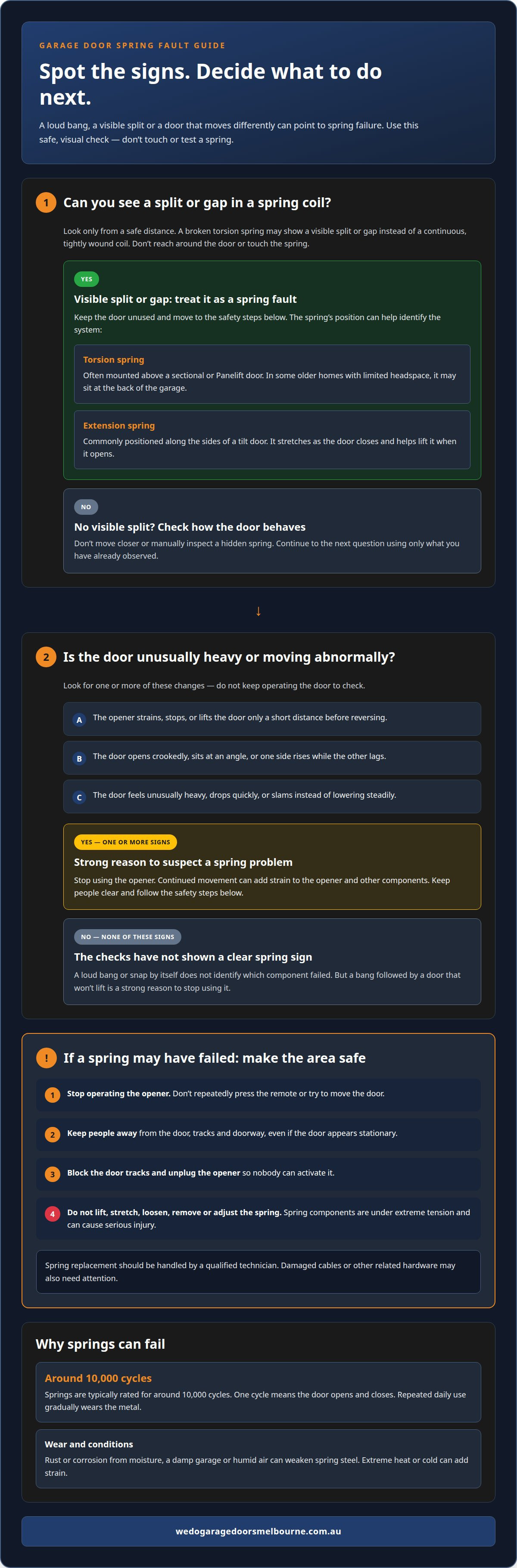
A garage door that suddenly feels heavy or won’t move properly may have a broken spring, and operating it can strain the door and opener. If you’re wondering how to know if a garage door spring is broken, look for a visible split, a crooked door or an opener that struggles to lift it. Stop using the opener if you suspect a spring has failed.
It’s understandable to wonder whether the problem is a spring or something else, especially when the door stops working without warning. Springs are typically rated for around 10,000 cycles, and wear, rust and moisture can contribute to failure over time. This guide explains the common causes, how torsion and extension spring problems can look, and why trying to operate or lift a door with a broken spring can be risky. You’ll also learn what to do next to keep people away from the door while the fault is addressed.
Table of Contents
What Causes a Garage Door Spring To Break?
Garage door springs wear as they help lift and lower the door. They’re typically rated for around 10,000 cycles, with one cycle meaning the door opens and closes. Regular daily use gradually wears the metal, so a spring can fail after years of repeated movement, even when the door has seemed to work normally.
Moisture can weaken spring steel through rust or corrosion. A damp garage or humid air can encourage corrosion, while extreme heat or cold can add strain to the metal. As a spring weakens, it may no longer hold tension evenly. The door can become harder to move, and other parts, such as cables, may come under added strain.
A loud bang or sharp snap can be an audible sign that a spring has broken. It may happen when the spring releases its tension under load, sometimes while the door is closed and nobody is nearby. The sound can resemble a heavy object striking the garage or a firecracker going off. Noise alone doesn’t identify the failed component, but a bang followed by a door that won’t lift is a strong reason to stop using it.
Can you replace a garage door spring yourself? A broken spring should be replaced by a qualified technician, not treated as a DIY repair. Springs are under extreme tension; attempting a DIY fix can cause serious injury.
What should you do if the spring breaks? Stop operating the opener, keep people clear, block the door tracks and unplug the opener so nobody can activate it. Don’t try to stretch, loosen or remove the spring.
How long does replacement take? The time depends on the spring type, door setup and condition of related hardware. A door with damaged cables may need attention beyond replacing the spring alone.
Torsion springs and extension springs
Garage door spring systems differ by door design and spring location. On a sectional or Panelift door, torsion springs are often mounted above the door. In older homes with limited headspace, they may sit at the back of the garage instead. A torsion spring does the heavy lifting, helping counterbalance the door as it moves.
What does a broken garage door torsion spring look like? Look for a visible split or gap in the coil instead of a continuous, tightly wound spring. Check from a safe distance without touching it. Springs are under extreme tension; attempting a DIY fix can cause serious injury. An opener that struggles to lift the door can be another warning sign.
Torsion springs are often made to suit a door’s size and weight, so they aren’t necessarily interchangeable. A mismatch can affect how the door balances and moves. The opener operates the door, while the spring counterbalances its weight. If you can’t clearly see the spring, don’t reach around the door or try to inspect it manually.
Tilt doors commonly use extension springs positioned along the sides. These springs stretch as the door closes, then help lift it when it opens. Their location and movement differ from a torsion system, which coils around a shaft. Tilt-door extension springs are made in set sizes and aren’t usually custom made, unlike many torsion springs.
Identifying the system helps explain what may have failed, but it doesn’t make spring handling safe. Don’t pull, stretch or adjust either type yourself. Keep the door unused if you spot a split or notice uneven movement, and arrange garage door spring replacement to address the fault.
A door that will not open or close properly
A garage door spring counterbalances the door’s weight, helping it move smoothly along its tracks. If a spring breaks, the door may become difficult to move or refuse to open. For example, an opener that previously raised the door without hesitation may suddenly strain, stop or reverse. Take a change in movement seriously, especially if it follows a loud snap or bang.
Watch the door’s position as it moves. In a double-spring setup, one failed spring can make the door open crookedly or sit at an angle. One side may rise while the other lags, leaving the door tilted in its tracks. Don’t keep operating it to see whether the imbalance corrects itself. Continued movement can increase strain on the opener and other components.
An opener may lift the door only a few centimetres before reversing if a spring has failed. That short movement suggests the mechanism is struggling to raise the door’s weight rather than completing its usual travel. Repeatedly pressing the remote won’t restore the spring’s support. Stop using the opener if it strains, reverses or leaves the door partly open.
A door that feels unusually heavy or drops quickly can also signal a balance problem. If it slams shut instead of lowering steadily, its springs may not be providing enough resistance. A door that won’t stay open after being raised manually with the opener disconnected can also point to a broken torsion spring. Don’t lift it yourself to test this if you suspect spring failure.
Note what happened before the fault: whether the door was moving, where it stopped and whether it sits level. These observations can help explain the problem during an assessment. A door that’s stuck, tilted or dropping quickly shouldn’t be treated as a routine opener glitch. Keep people clear and leave further checks and repairs to a qualified technician.
Risks of operating a door with a broken spring
A broken spring removes support that helps balance the door, leaving the opener to work against much more of its weight. Continued operation can burn out the motor or damage other components, adding problems beyond the spring replacement.
The door may also lose control while moving. If its springs can’t provide enough resistance, it may slam shut or drop quickly instead of lowering steadily. This creates a serious risk for anyone beneath it, near its tracks or reaching into the doorway. Keep household members and visitors away, even when the door appears stationary.
Don’t try to lift a door manually if you suspect a broken spring. Its unexpected weight can strain muscles, and hands or fingers can get caught between moving parts. Springs are under extreme tension; attempting a DIY fix can cause serious injury.
Leave the opener switched off and unplugged so nobody can activate it accidentally. Block the tracks to discourage anyone from moving the door, and keep clear of cables and spring components. If the door is open, don’t pull the red emergency cord to disconnect the opener. Disconnecting it in that position can let the door come crashing down.
These precautions matter even if you need to get a car out or close the garage before leaving. Don’t repeatedly press the remote, force the door down or ask someone to hold it. Keep people clear and arrange professional attention for the failed spring. If the opener has been straining, have its condition assessed alongside the spring fault.
For a door that may fall or an opener under strain, arrange professional spring replacement rather than attempting to operate or repair the system yourself.
We Do Garage Doors: Garage door repairs
We Do Garage Doors can help if a suspected broken spring leaves your door stuck, uneven or unsafe to operate. Its garage door repair service includes spring replacement to address the fault behind the door’s lost balance. If the opener has also been strained, motor replacement is available as a separate repair.
Once the spring fault is repaired, smart door control can be considered as a separate retrofit, not a substitute for fixing damaged hardware. It works with the existing door and motor. Avoid operating the door while you wait for repairs, and keep people clear of its path. Contact We Do Garage Doors to discuss your garage door repair.
Choose a safe next step for your garage
If you’re still wondering how to know if your garage door spring is broken, don’t risk testing the door. A safer next step is to arrange an assessment and explain what you’ve noticed, such as when the problem began and how the door behaved. Those details can help identify the fault and any related repair needs.
We Do Garage Doors offers garage door repairs, spring replacement and motor replacement in Melbourne, including Greenvale, Craigieburn, Mickleham, Roxburgh Park and Wollert. The repair can address the spring fault and any opener issue that needs attention. Contact the team to arrange an assessment and get the right repair underway.
Contact We Do Garage Doors today to discuss the repair. You’ve already taken a useful first step by recognising that a faulty spring needs care. With the door left unused and the repair handled professionally, you can focus on restoring safe, reliable access to your garage.
Frequently Asked Questions
How do I know when a spring is broken?
A visible gap in a coil, a sudden loud bang or a change in how the door moves can indicate spring failure. To know whether a garage door spring is broken, consider several signs together rather than relying on one symptom. For example, a bang followed by an opener that stops shortly after starting is more concerning than an isolated noise. Don’t touch the spring to confirm.
What are the signs of a broken garage door spring?
Common signs include a split in a torsion spring, a door that sits unevenly or an opener that struggles to move it. The door may also feel unusually heavy or move unpredictably. If you hear a bang but the door still operates, don’t assume it’s safe. Stop using it and look from a distance for visible changes.
How can you tell if a garage door spring is broken or just out of adjustment?
A visible break points to a broken spring, while uneven travel without an obvious split can have other causes. For example, a door that stops at the same point each time may have an opener or track issue rather than a clearly broken spring. Don’t adjust spring tension yourself. A technician can assess the spring and related parts safely.
Can you open a garage door with a broken spring?
An opener may start lifting the door but struggle, stop or reverse because the spring no longer helps counterbalance its weight. Don’t keep pressing the remote or try to lift the door by hand. If a vehicle is inside, don’t force the door to gain access. Leave it in place and arrange a professional assessment before operating it again.
Is it safe to use a garage door with a broken spring?
No. A door with a broken spring can move unpredictably, and continued opener use can strain the motor and other hardware. Keep children, visitors and pets away from the doorway, and don’t stand beneath a raised door. Avoid pulling the emergency release if the door is open, as disconnecting the opener can leave the door unsupported.
Are garage door torsion springs and extension springs different?
Yes. Torsion springs usually sit above a sectional door or at the back of a garage with limited headspace, and they coil around a shaft. Extension springs are commonly positioned beside tilt doors and stretch as the door closes. Their locations and movement differ, so identifying the type can help you describe the problem, but neither spring should be handled or adjusted by hand.
Comments