

Garage Door Opens a Little Then Stops? Causes and Safe Next Steps
What if the opener isn’t the part stopping your garage door? When a garage door opens a little then stops, it’s natural to suspect the motor, especially when your car or household access is blocked. But the way the door moves can point to other causes, including an obstruction, a movement problem or a fault with the opener. Repeatedly pressing the remote may make the issue worse.
You’ll find out what the movement pattern can tell you, which simple checks are safe to make, and when it’s best to stop and arrange a repair. We’ll also explain why you should never attempt to adjust springs yourself: they’re under extreme tension and can cause serious injury.
For homeowners in Melbourne, We Do Garage Doors can inspect the door, opener and operating behaviour to identify the repair needed. Every repair, installed part and new installation comes with a 1-year warranty. Read on for calm, practical next steps to help restore safe, reliable access.
Table of Contents
Garage door opens a little then stops: what the symptom tells you
A door that starts upwards but stops before reaching its usual open position can be frustrating, especially when you need to get your car out. The symptom has several possible causes; by itself, it doesn’t identify one fault or prove that the motor or a spring has failed. A few careful observations can help describe what’s happening without taking anything apart or repeatedly testing the door.
What does a garage door that stops partway mean?
Notice whether the door stops at roughly the same point each time or whether its behaviour varies. A consistent stopping point is useful information to report, while unpredictable movement is worth describing just as clearly. Neither pattern confirms a particular fault. The door, opener and safety systems work together as the door travels, so a disruption in movement may involve more than one part of the system.
The opener supplies movement, while the door travels along its tracks and the safety system helps manage operation. You can read a general overview of garage door opener mechanisms to understand how openers operate, but the symptom alone can’t tell you which component needs attention. A technician can assess the door and opener together rather than relying on a guess based on where it stops.
What to notice before troubleshooting
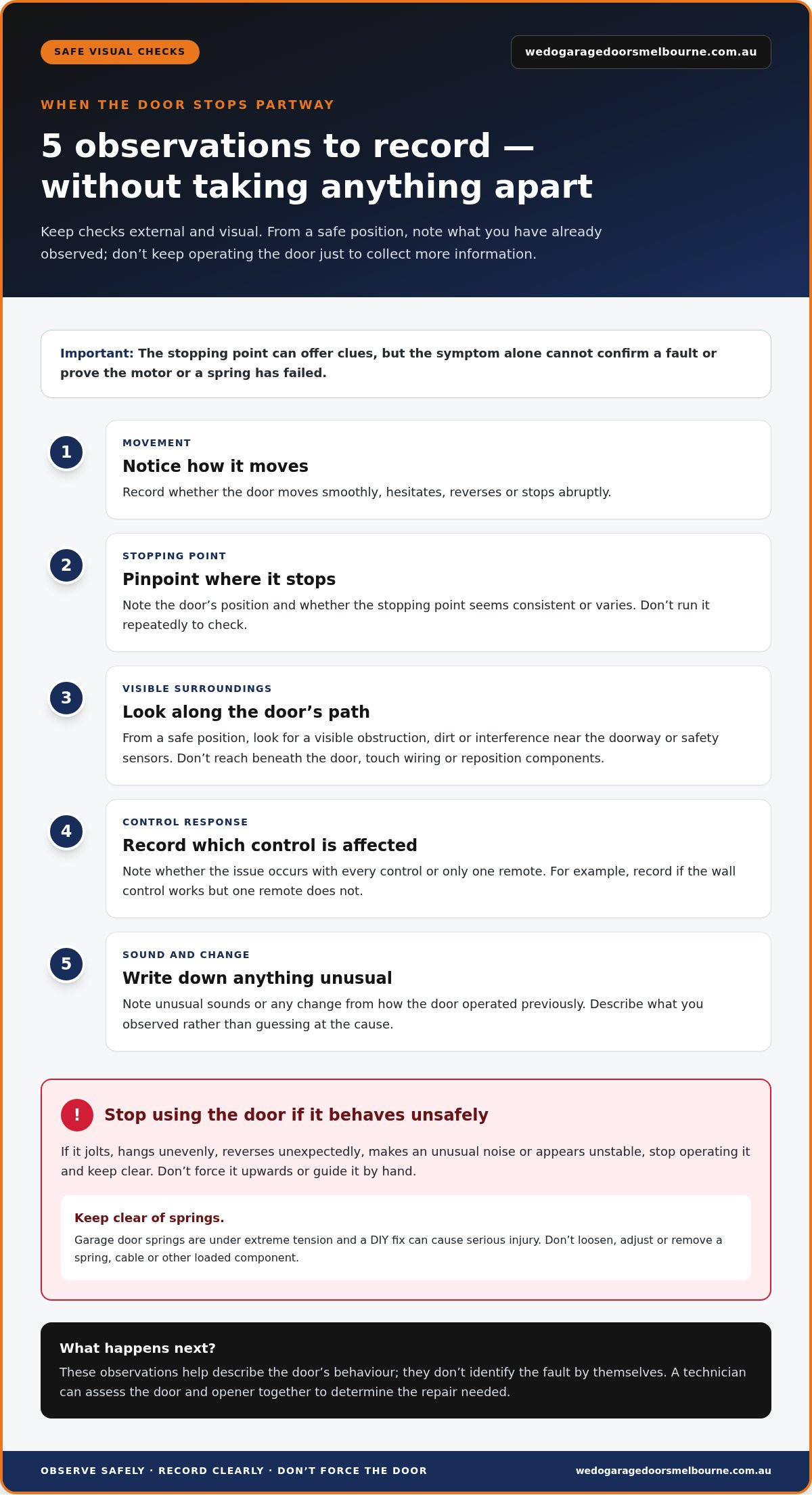
From a safe position, pay attention to what the door does during the movement you’ve already observed. Don’t keep operating it just to collect more information. Record details such as:
Whether it moves smoothly, hesitates, reverses or stops abruptly.
Where it stops, and whether that point seems consistent.
Any visible obstruction near the door’s path or safety sensors.
Any unusual sound or change from how the door operated previously.
Whether the same issue occurs with every control or only one remote.
For example, if the wall control operates the door but one remote doesn’t, note that difference. If the door stops at the same height regardless of which control you use, record that too. These details help distinguish what you observed from what you might suspect, making it easier for a technician to investigate the door’s operating behaviour.
Repeated operation isn’t a substitute for finding the cause. If the door jolts, hangs unevenly, reverses unexpectedly, makes an unusual noise or appears unstable, stop using it and keep clear. Don’t force it upwards or try to guide it by hand. A clear record of its movement, stopping point and control response is more useful, and safer, than repeated attempts that could worsen the fault.
Why a garage door may open partway then stop
If your garage door opens a little then stops, there are several possible explanations. A visible obstruction, an issue with the safety system, resistance as the door moves, or an opener travel or control problem may interrupt normal operation. The stopping point can offer clues, but it can’t confirm the cause on its own. A technician needs to assess how the opener and door behave together.
Obstructions, safety sensors, and interrupted movement
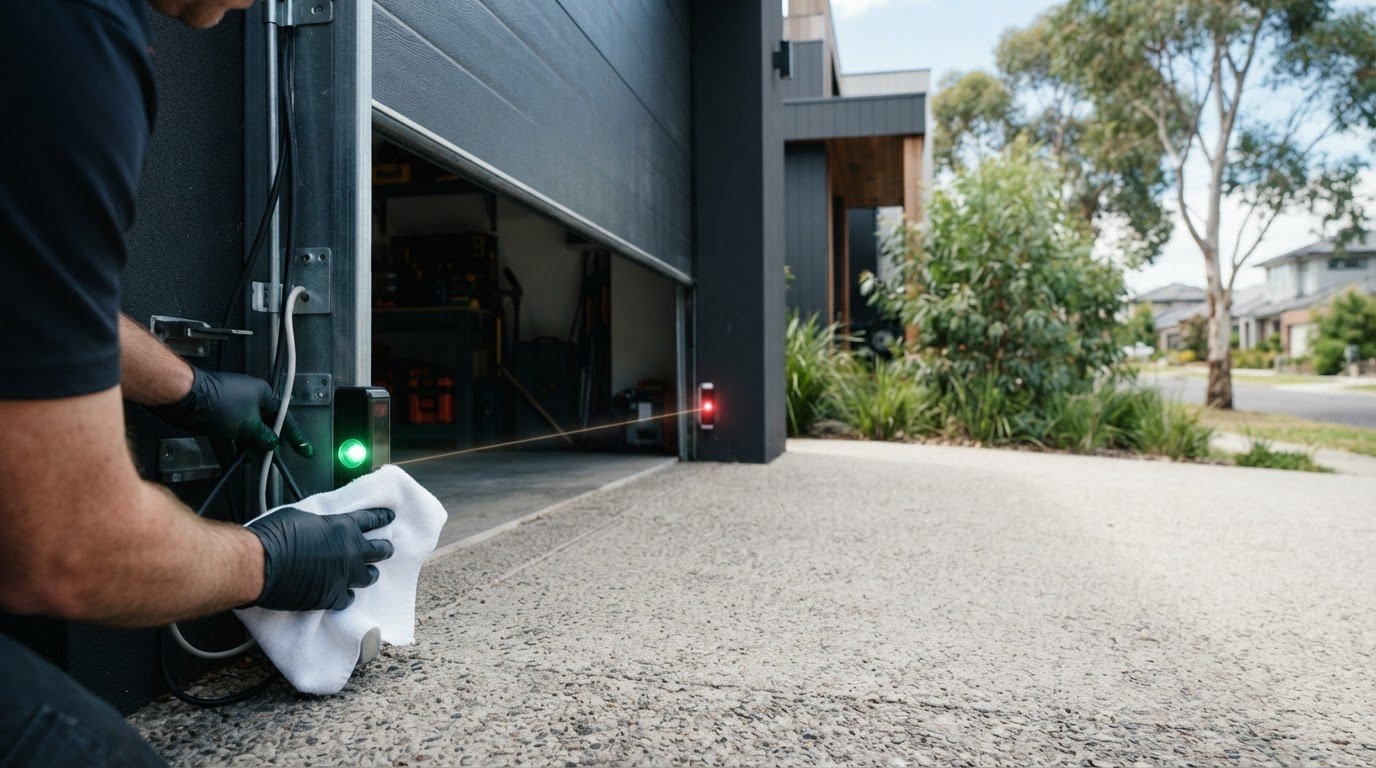
Start with what you can see from a safe position. Look along the doorway and around the sensor area for an item, dirt or other visible interference that might affect the door’s path or safety system. Keep clear of moving parts, and don’t touch wiring or try to reposition components. An interruption doesn’t automatically mean a sensor is faulty; the door’s behaviour needs to be assessed in context.
Even something small in the travel path may affect movement, while a safety-system issue can interrupt operation to prevent the door continuing. If there’s nothing obvious, that doesn’t rule out a problem. Avoid reaching beneath the door or attempting to bypass a safety feature. Make a note of what you can see, then leave further investigation to a technician if the issue persists.
Door resistance, opener travel, and mechanical faults
Notice whether the door seems to strain, jerk, hesitate or move unevenly. These behaviours may be associated with resistance or a mechanical issue in the door itself, rather than a fault in the opener alone. Tracks, moving components and the door’s balance all affect how it travels. In some instances, track misalignment or frame distortion can even stem from shifting ground or an unlevel garage slab, an issue that concrete repair specialists like Foundation Werks often resolve to keep structural openings square and stable. Don’t try to lift or force a door that appears heavy, crooked or unstable.
Opener travel or force settings can also affect how far the door moves, but changing settings by guesswork may hide the underlying issue or affect safe operation. If the opener runs but the door barely moves, or the door stops at different points, share that detail with the technician instead of adjusting the controls. The same symptom can have different causes, so diagnosis should follow an inspection rather than an assumption.
Keep clear of springs. Garage door springs are under extreme tension, and attempting a DIY fix can cause serious injury. Don’t loosen, adjust or remove a spring, cable or other loaded component. If you can see damage, or the door is hanging unevenly, stop operating it and arrange a professional inspection.
For homeowners in Melbourne, We Do Garage Doors can inspect the door and opener to identify the repair needed. If the movement remains concerning after a visual check, arranging garage door repair in Melbourne is a safer next step than experimenting with settings or repeatedly cycling the door.
How to narrow down the cause without risking damage
A few cautious checks can help you describe the problem, but they won’t replace an inspection. If your garage door opens a little then stops, keep every check external and visual. Don’t remove covers, reach into the mechanism or try to alter settings. Follow this sequence only while the door is stationary and appears safe to operate.
Observe the door. From a safe position, note where it stopped and whether it looks level, crooked or visibly damaged. If it’s hanging unevenly, jammed or unstable, don’t operate it again.
Check for a visible obstruction. Look along the doorway and the area around the sensors for an object in the door’s path. Remove an item only if you can reach it safely without going near moving parts or touching wiring.
Try another existing control. If the door is stationary and looks safe, try the wall control if you were using a remote, or another existing remote. Note whether the response changes. Don’t keep cycling the door to test it.
Stop if the issue remains. If the door still stops, moves unpredictably or shows signs of damage, leave it alone and arrange a professional inspection.
Safe checks you can make from outside the mechanism
Keep your attention on what you can see: the door’s position, its visible path and whether an obvious object is in the way. Don’t push a crooked door, pull on cables or try to free a jam by hand. If you’re unsure whether an obstruction is safely reachable, leave it in place. A clear description of what you observed is more useful than risking damage to investigate further.
Controls and opener functions can differ between models, so consult the manual for model-specific control checks. Use it for information about the controls only; don’t interpret it as a reason to adjust force or travel settings by guesswork. If you need broader repair context, the garage door repairs Melbourne guide explains how repair needs can be assessed.
When to stop and leave the door alone
Stop operating the door if it’s unstable, uneven, unusually noisy or visibly damaged. Don’t adjust springs, cables or opener force and travel settings yourself. Springs are under extreme tension, and attempting a DIY fix can cause serious injury. If the opener seems to respond differently from the door, note what happens rather than assuming the motor is the cause. For background on motor-related symptoms, see the garage door motor replacement guide.
Once you’ve completed the safe checks, avoid further attempts if the fault persists. We Do Garage Doors can inspect the door and opener to identify the repair needed. If you’re concerned about the door’s movement, arranging garage door repairs in Melbourne is a sensible next step.
What to do when your garage door keeps stopping partway
If the door stops more than once, resist the temptation to keep pressing the remote. Repeated operation won’t identify the fault and may put extra strain on a door or opener that isn’t moving properly. Leave it stationary if it seems unstable, uneven or damaged. A short record of what happened can help a technician understand the problem and inspect the right parts of the system.
What information helps a technician diagnose the fault?
Write down where the door stopped and whether it stopped at a consistent point or at different points. Describe what you saw and heard, such as a hesitation, uneven travel, abrupt stop or unusual noise. Note any visible obstruction and any change in how the door has operated. Include which controls you tried and whether using another control changed the response.
Keep the notes factual. For example, say “stopped just above the halfway point” rather than assuming the motor or spring is faulty. If you took a photo from a safe distance, it may help show the door’s position or visible damage, but don’t move the door or approach a component to get a closer view. Share what you observed, along with any safe checks already attempted.
When a professional inspection is the safer next step
Arrange an inspection if the door repeatedly stops, moves unevenly or appears damaged. We Do Garage Doors repairs residential garage doors across Melbourne, with a focus on the northern suburbs. A technician can inspect the door, opener and operating behaviour before discussing the repair needed. Same-day attendance is available in most cases, particularly across the northern suburbs, and emergency repairs are available 24/7.
If you suspect spring damage, don’t touch or adjust the spring. Garage door springs are under extreme tension, and a DIY attempt can cause serious injury. The garage door spring safety guide explains why spring issues need careful handling. Until the door has been assessed, keep clear and don’t try to force it open or closed.
To help the repair process, have your notes ready and explain whether the fault affects every control or only one. We Do Garage Doors has over 12 years of local experience, and every repair, installed part and new installation comes with a 1-year warranty. If your door keeps stopping partway, arrange a garage door repair so the door and opener can be assessed and the next steps discussed.
Garage door repair in Melbourne: what happens next
If your garage door opens a little then stops, you don’t need to identify the fault before arranging help. We Do Garage Doors inspects the door and opener, considers how the system behaves, then discusses the repair needed. This helps connect the symptom you’ve observed with the work required, rather than relying on a guess based on the stopping point alone.
General repairs start around A$150, depending on the work required. The final repair needed can vary with the fault and the door’s condition, so the inspection helps clarify the next step. Every repair, installed part and new installation comes with a 1-year warranty, giving you a clear point of reassurance as you get access working reliably again.
Local garage door repair across Melbourne’s northern suburbs
We Do Garage Doors provides residential garage door repairs across Melbourne, with a focus on the northern suburbs. Service locations include Greenvale, Craigieburn, Mickleham, Roxburgh Park and Wollert, as well as Epping, Broadmeadows, Preston and Reservoir. Same-day service is available in most cases, particularly across the northern suburbs, but attendance isn’t guaranteed across the entire Melbourne service area. Emergency repairs are available 24/7.
When arranging a repair, share your suburb and a brief description of what the door is doing. If you’ve noted where it stops, whether its movement is uneven, or which control you tried, those details can help explain the issue. You can also mention any visible damage or unusual noise. Don’t keep operating the door to gather more information if it seems unsafe.
Arrange a repair with We Do Garage Doors
With over 12 years of garage-door repair and installation experience in Melbourne, We Do Garage Doors can assess the door and opener and discuss the repair required. Once the work is completed, the 1-year warranty applies to every repair, installed part and new installation. The aim is to make the process clear, from understanding the symptom to knowing what repair is recommended.
To discuss a repair, call 0423 746 364 or email chrispdoors@gmail.com. For a garage door that keeps stopping partway, arrange a garage door repair with We Do Garage Doors.
Get your garage access back on track
A garage door that stops partway can disrupt more than a trip in and out. It can affect your plans, household routines and confidence in the security of your home. If the garage door opens a little then stops, avoid treating repeated attempts as a workable fix. A considered repair can help you move from uncertainty towards a safer, more dependable way to use the door.
Taking the next step doesn’t mean you need to know what has failed. Leave the door in a safe position, share what you observed and let an experienced technician assess the issue. Clear information and a proper inspection help shape the repair around the fault, rather than relying on guesswork. While commercial properties often rely on property maintenance providers such as Service King Commercial to manage trade solutions and physical infrastructure repairs, residential property owners can consult a dedicated garage door technician to make decisions with a better understanding of what their door needs.
We Do Garage Doors brings over 12 years of local garage-door repair and installation experience. Every repair, installed part and new installation is covered by a 1-year warranty, and 24/7 emergency repairs are available. Take the next step towards reliable access: arrange a garage door repair with We Do Garage Doors. A safe, smoothly operating door is within reach.
Frequently Asked Questions
Why does my garage door stop opening at the same spot?
A consistent stopping point is a useful clue, but it doesn’t confirm a specific fault. Opener travel, an interruption along the door’s path or resistance as the door moves could all be relevant. Note the stopping position in relation to a recognisable feature, such as a window or panel join, and describe whether the movement was smooth. Avoid changing settings or mechanical parts by guesswork; arrange an inspection if it keeps happening.
Can I keep using my garage door if it only opens partway?
It’s best to stop using it if it repeatedly stops, moves unevenly, makes an unusual noise or appears damaged. Continuing could leave the door stuck in an inconvenient position or place extra strain on the system. Don’t force it open or closed, and don’t work on springs or cables. If the door is stationary and secure, note what happened and seek professional advice before trying to operate it again.
Could a garage door opener cause the door to stop before it is fully open?
Yes, the opener or its travel settings could be one possible factor, but a garage door opens a little then stops symptom doesn’t prove the opener is faulty. The door’s movement and anything interrupting its path matter too. Don’t adjust force or travel settings without model-specific guidance. A technician can assess the opener alongside the door, helping ensure the recommended repair addresses the cause rather than just the visible symptom.
What should I do if my garage door stops halfway and will not move?
Don’t push or pull the door to try to free it. From a safe position, look for an obvious obstruction, but leave the door alone if it appears crooked, unstable or damaged. Keep well clear of springs and cables, which can cause serious injury if handled. If it remains stuck, arrange a professional inspection. We Do Garage Doors also provides 24/7 emergency repairs for urgent garage door problems.
Can a broken garage door spring make the door stop partway?
A spring problem can affect door movement, but stopping partway doesn’t confirm that a spring is broken. Don’t test, loosen or replace a spring yourself. Springs are under extreme tension; attempting a DIY fix can cause serious injury. If you notice visible damage or the door moves abnormally, stop operating it and arrange a professional inspection. Describe what you’ve observed without touching the spring or nearby components.
How quickly can a garage door repair be completed in Melbourne?
Most repairs are completed in a single visit, usually within an hour or two. If a part needs to be ordered for a less common door brand or model, We Do Garage Doors will let you know upfront. Same-day attendance is available in most cases, particularly across Melbourne’s northern suburbs, but isn’t guaranteed throughout the whole service area. The time needed depends on the repair and whether a part is required.
Comments